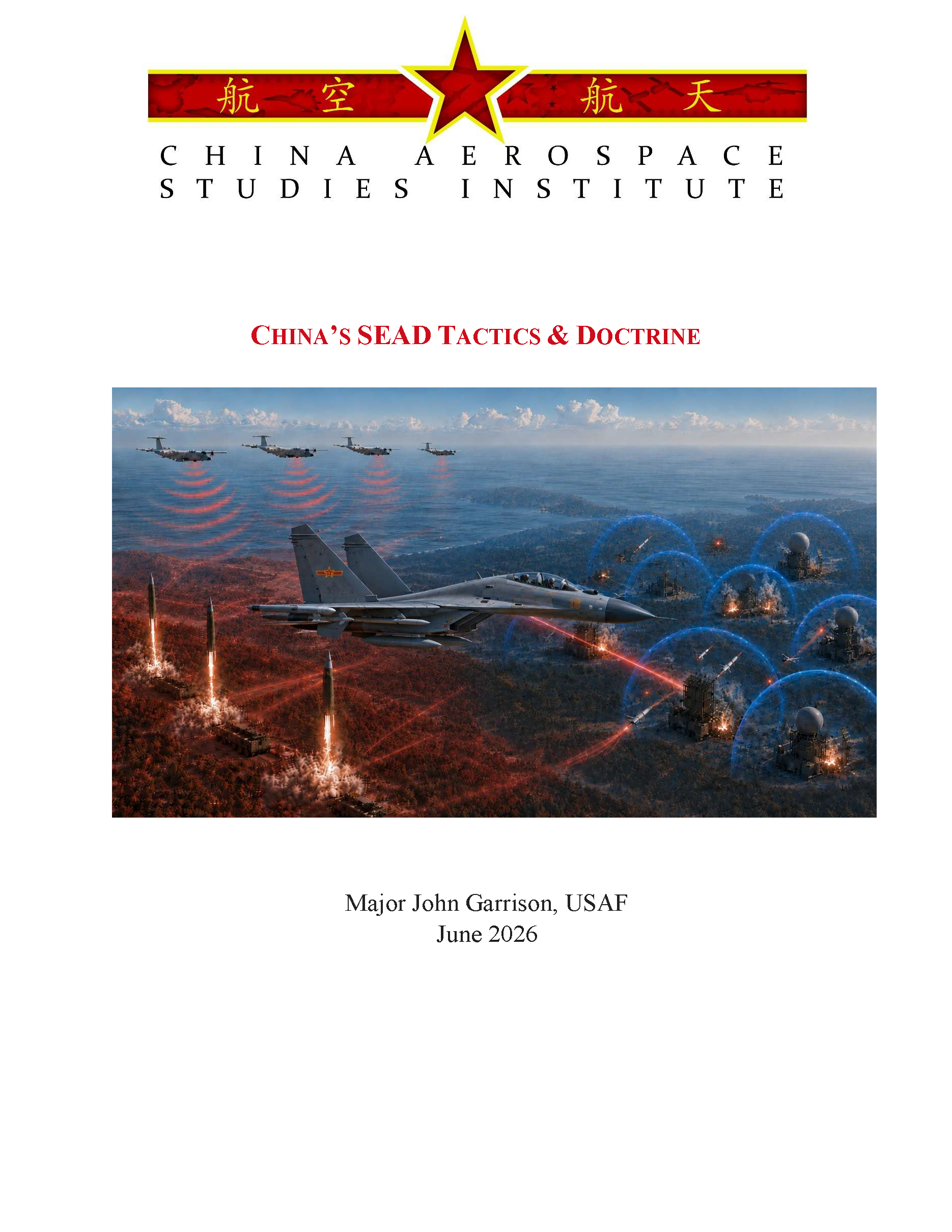
Modern air warfare has demonstrated air superiority can no longer be assumed, even by technologically advanced militaries. The proliferation of mobile, networked, and resilient air defense systems has engendered a crucial shift. Once characterized by rapid dominance, aerial campaigns now manifest as prolonged contests over detection, tracking, and control of the electromagnetic spectrum. To project power, maneuver, and control escalation, suppression of enemy air defenses (SEAD) is no longer a support function; it is a prerequisite. In a Taiwan contingency, the People’s Liberation Army’s (PLA) ability to suppress Taiwan’s air defense network will shape the opening phase of the conflict and follow-on operations to include amphibious assault or airborne insertion.
Chinese military thinkers explicitly recognize this reality. In their writings, the PLA frames SEAD as a logical development required to expand China’s security interests and for its military to “go global” by protecting overseas assets, citizens, and influence. Unlike Western SEAD concepts, shaped by decades of combat experience and iterative adaptation, Chinese SEAD doctrine developed in the absence of combat. As a result, PLA authors emphasize preplanned effects, long-range fires, electromagnetic dominance, and unmanned systems as means to engineer windows of air superiority, while minimizing the exposure of high-value manned platforms to air defense threats. The PLA’s approach reflects broader features of Chinese military thought, including active defense, systems confrontation, and a preference for systems engineering solutions to operational problems.
The war in Ukraine, however, highlights the limitations of viewing air defense suppression as a deterministic engineering challenge. Adaptive defenders leveraging mobility, deception, and emission control have shown that SEAD is fundamentally a competitive interaction with a thinking adversary rather than a problem that is static where targets can be eliminated one at a time. These competitive dynamics are relevant to Taiwan, where similar approaches could exploit Chinese weaknesses in reactive (real-time integrated) SEAD and significantly complicate PLA efforts to achieve air superiority.
This paper argues the PLA is developing a coherent approach to SEAD, but that this effort remains unevenly translated from doctrine into operational capability. Chinese SEAD thinking is sophisticated at the conceptual level, emphasizing Electromagnetic warfare, system paralysis, and tightly coordinated, preplanned joint firepower strikes. These ideas are well developed in PLA doctrinal writings and academic analyses. However, the platforms, weapons, training, and tactical integration required to execute adaptive, real-time SEAD against a resilient and learning adversary remain immature.
Click here for the full report